

M.D. Anatomy
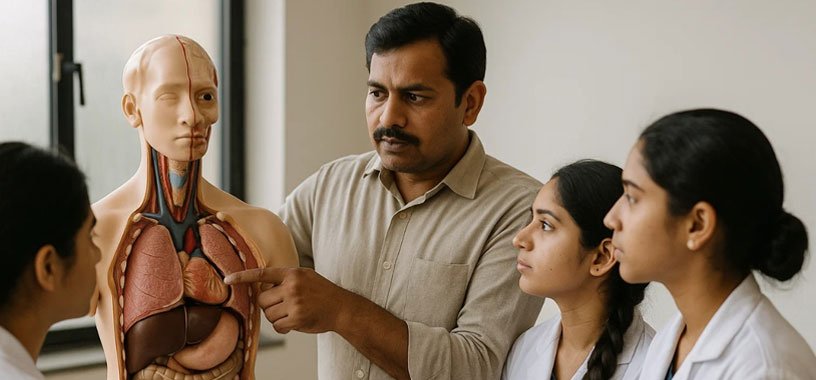
M.D. Anatomy trains future medical educators and researchers in the structural sciences through hands-on dissection, microscopy, imaging, and applied anatomy—developing expertise essential for teaching, clinical correlation, and medico-legal interpretation.
Overview
M.D. in Anatomy is a 3-year postgraduate program designed to produce competent anatomists who are skilled in teaching, dissection, research, and clinical correlation. The course emphasizes gross and microscopic anatomy, embryology, neuroanatomy, genetics, and recent advancements to train medical educators and researchers.
The program builds strong skills in dissection, histology, embryology, neuroanatomy, and applied anatomy—preparing students for academic, clinical, and research roles in anatomy.
Gross Anatomy, Surface & Radiological Anatomy
Embryology and Developmental Biology
Cell Biology, Histology & Histochemistry
Neuroanatomy and Functional Mapping
Genetics and Cytogenetics
Applied & Clinical Anatomy
Immunology and Comparative Anatomy
Anthropology, Forensic Anatomy, and Imaging
Core Curriculum
Year 1:
Subjects
Topic
Gross Anatomy
Upper Limb, Lower Limb, Thorax, Abdomen, Pelvis, Perineum, Head & Neck, Osteology, Cross-Sectional Anatomy, Body Preservation
Embryology
Gametogenesis, Fertilization, Implantation, Placenta, System Development, Teratology, Congenital Anomalies
Histology & Histochemistry
Microscopy Types, Cell Biology, Tissue Structure, Staining, Histo-Techniques
Neuroanatomy – Basics
Brain & Spinal Cord Dissection, Neuron Types, Early Neural Development
Genetics – Introduction
Brain & Spinal Cord Dissection, Neuron Types, Early Neural Development
Immunology – Fundamentals
Immune organs, lymphoid tissue, MHC, PCR in immunology
Year 2:
Subjects
Topic
Neuroanatomy
Tracts, Pathways, Hypothalamo-Hypophyseal System, Limbic System, Basal Ganglia, Ventricular System, Radiology
Embryology
Organ-Specific Development, Congenital Malformations
Histology
Organs, Tissues, Cellular Correlation, Em Images
Genetics
Genetic syndromes, cytogenetics, banding, pedigree, gene therapy
Imaging Anatomy
X-rays, CT, MRI, contrast imaging
Immunology – Fundamentals
Immune Organs, Lymphoid Tissue, Mhc, Pcr In Immunology
Year 3:
Subjects
Topic
Applied & Clinical Anatomy
Anatomy in surgery & medicine, radiological correlation, anatomy of procedures
Comparative & Evolutionary Anatomy
Human evolution, anthropometry, forensic application
Surface Anatomy & Radiology
Surface marking, radiographs, barium studies, pyelograms, USG, CT/MRI interpretation
Eligibility Criteria:
- Annual Intake:
- 3 seats per year
- Eligibility Criteria:
- The candidate must have a recognized MBBS degree or an equivalent qualification.
- Must have completed a one-year compulsory rotating internship before the start of the course.
- Must be registered with the Medical Council of India (MCI) or any State Medical Council (or must obtain registration within one month of admission).
- Admission is based on merit in NEET-PG, with a minimum 50 percentile, or as per norms set by the Government of India.
- The candidate must be eligible and available to work as a full-time resident student for the full course duration.
- Selection will be according to current NMC/MCI rules and university guidelines.
- Duration:
- 3 years
Contact Us
Krishna Vishwa Vidyapeeth, Karad Malkapur, Karad (Dist.Satara), Maharashtra, India. PIN - 415539