

Diploma in Ophthalmic Technology
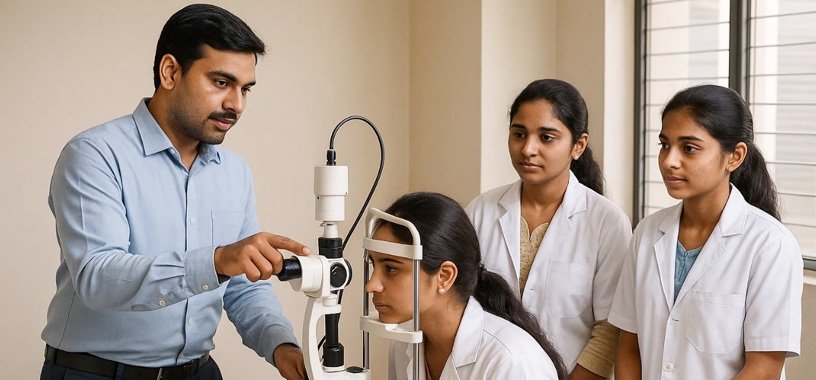
The Diploma in Ophthalmic Technology (DOT) provides hands-on training in eye examinations, refraction, optical dispensing, and ophthalmic equipment handling—preparing students to assist eye care professionals in clinics, hospitals, and community outreach programs.
Overview
The Diploma in Ophthalmic Technology is a comprehensive two-year program that trains students in eye care diagnostics, ophthalmic equipment handling, clinical procedures, community eye health, and optical dispensing. It integrates basic sciences, clinical techniques, and public health to prepare skilled ophthalmic assistants to support ophthalmologists in hospitals, clinics, and community outreach.
The program fosters comprehensive understanding and skill development in eye anatomy, vision assessment, clinical procedures, optical dispensing, and ophthalmic equipment handling.
Anatomy, physiology, and pathology of the eye
Basics of microbiology and ocular pharmacology
Common eye diseases and trauma management
Visual acuity assessment and refraction
Optics and dispensing of glasses
Operation theatre assistance and sterilization
Community eye care, blindness prevention programs
Use and maintenance of ophthalmic equipment (slit lamp, tonometer, ophthalmoscope)
Secretarial skills and functional English
Computer basics and health record management
Students delve into eye care from fundamentals to advanced techniques—covering anatomy, refraction, ophthalmic diseases, surgical assistance, and optical dispensing—building strong skills for clinical practice and community eye health.
Core Curriculum
Semester 1:
Subjects
Topic
Anatomy & Physiology of the Eye
Anatomy of Eyeball, Eyelid & Conjunctiva, Lacrimal apparatus, Extra ocular muscles, Cornea and Sclera, Iris, Ciliary body and Choroid, Retina and optic nerve, Lens and Vitreous, Visual pathway, Anterior chamber angle; Physiology of Vision: Ocular motility and binocular Vision, corneal and lens physiology, Pupillary reactions, Color Vision, Intraocular Pressure & aqueous humor, Visual fields
Microbiology
Introduction to Microbiology, Classification of Microorganisms, Collection of Swabs – Staining, culture, Morphology of Bacteria, Fungi, Viruses – affecting the Eye
Pathology
Introduction to Pathology, Infection and Inflammation, Oedema, healing, repair, Routine blood and urine examination
Basics in Ocular Pharmacology
Introduction to Pharmacology, General Aspects of Pharmacology and Prescription writing, pharmacodynamics, Routes of delivery of ophthalmic drugs, Common Ophthalmic drugs - Classification/uses/examples
Common Eye Diseases
Diseases of Eyelids, Orbit, Adnexa; Diseases of Conjunctiva and cornea; Diseases of Sclera, Uvea; Diseases of Lens; Glaucoma; Diseases of vitreous and Retina; Trauma; Systemic diseases and eye
Optics & Refraction
Properties of light, Lenses and their combinations, Transposition of spectacle lenses, Human eye as a optical system, Visual Angles, Visual Acuity and Visual Axes, Refractive errors, Accommodation and Convergence, Low vision aids
Orientation to Clinical techniques and preoperative workup
History taking, Blood pressure, Torch examination, Visual acuity, tonometry, Sac syringing
Semester 2:
Subjects
Topic
Community Eye Care
Blindness causes and magnitude, childhood blindness, eye care levels (primary, secondary, tertiary), rehabilitation, eye banking, public health optometry
Operation Theatre Assistance
Sterilization, surgical instruments, OT setup, scrubbing, draping, autoclaving, fumigation
Care & Maintenance of Ophthalmic Equipment
Torch, slit lamp, retinoscope, ophthalmoscope, phacoemulsification unit, tonometer, vitrectomy system
Clinical Techniques
Visual acuity testing, retinoscopy, subjective refraction, lensometry, slit lamp exam (SLE), tonometry, ophthalmoscopy, color vision test, keratometry, pachymetry, A-Scan biometry, IOL power calculation
Dispensing Optics
Types of lenses and frames, pupillary distance, bifocals and multifocals, safety lenses, surfacing, lens fitting and grinding
Secretarial Skills
Patient interaction, ethics, case sheet preparation, telephone/email etiquette, patient counseling
Functional English & Computer Fundamentals
MS Word, Excel, PowerPoint, internet use, grammar basics, sentence formation, record maintenance
Eligibility Criteria:
- Annual Intake:
- 5 seats per year
- Eligibility Criteria:
- The candidate must have passed the 10+2 (Higher Secondary School Certificate) examination in the Science stream with a minimum of 50% marks from a recognized board.
- Duration:
- 1 year
Contact Us
Krishna Vishwa Vidyapeeth, Karad Malkapur, Karad (Dist.Satara), Maharashtra, India. PIN - 415539